
How Should I Practice the Piano?
Strategies to Make the Most of Your Daily Piano Practice
I've said it before: while finding the right piano teacher, listening to great music, upgrading your piano, and watching helpful YouTube videos
can all support your growth as a pianist, the bulk of your progress will happen when you sit down and actually practice.
Do you remember the old Nike slogan, "Just do it"? That applies to pianists, too.
But many students know they should practice and aren't entirely sure what that should look like.
So you sit down at the piano, pull out your music, and...
Now what?
Before we get into specific, level appropriate strategies, let’s start with two essential concepts every pianist needs to have in place when they sit down at the piano:
Playing vs. Practicing
Remember, playing and practicing are two different things. When we play, we're simply playing and enjoying—playing through favorite pieces, revisiting old songs, or trying out something new. Playing is usually relaxed and not especially goal-focused.
And that's a good thing! Playing is the reward of practicing. It's where we get to enjoy all the hard work we've put in. Practicing is mindful, calculated, and goal oriented.
Playing is important, but If we want to make progress, we need efficient and goal oriented sessions at the piano too.
Consistency
Pianists of all levels should aim to sit down and practice 5–6 days per week. With my younger students, I often put little boxes at the bottom of their music that they can check off each time they play a song. It helps them see the fundamental truth to practice: while the first few repetitions are often slow and awkward, by repetitions 10, 15, or 20, the piece feels dramatically easier.
This truth doesn't change as we advance. The only difference is that bigger, more complex pieces require more repetitions. Consistent practice, over time, is what turns difficult music into comfortable music- no matter what your level is!
Beginners
In addition to consistency, beginners should work on a gentle awareness of “how it’s going?” and a few basic techniques to help refine, or unstick, when it’s not going as well as they hope. The most difficult piece at this stage is taking the emotion out of this awareness. It won’t be easy, or perfect, at first, and that’s ok! Try not to get too upset if it’s not perfect, just take a breath and untwist the knotty spot.
Here’s a good, basic routine for beginning pianists:
Start by playing your song from beginning to end, slowly. Then do it again. Even if it's perfect every time, repetition is important for building motor skills and strengthening mental connections.
Did anything feel especially difficult? If so, you've found what you need to practice. Go back and play that tricky line, measure, or section 5–10 times. Then play the entire song again. Is it a little easier? If so, you're practicing correctly.
But what if you can't play the song at all?
That's when it's time to pull out my "Three Tricks for Making Hard Songs Easier":
Play it very slowly.
Practice in small sections (one page, one line, or even one measure at a time).
Practice one hand at a time before attempting hands together.
I've created a simple PDF that outlines these tricks and encourage all of my beginning pianists to keep a copy by their piano at home. You'll find a free download link at the end of this article.
If a song feels overwhelming, apply one trick, two tricks, or all three at once. These strategies can turn even the trickiest beginner piece into something manageable.
Once you can play the song reasonably steadily and comfortably, it's time to polish it:
Add the dynamics.
Double-check your rhythms.
Make sure your beat is steady and that your tempo matches the mood of the piece and the composer's instructions.
Beginning practice doesn't need to be painful, lengthy, or tedious. It just needs to be consistent and goal-focused.
Elementary & Intermediate Pianists
As you advance as a pianist, your music becomes more complicated. There are more notes, more rhythms, more technical challenges, and more musical details to consider. It can be tempting to try to tackle everything at once. Now, that's a fast path to overwhelm!
Instead, try starting with just the biggest building blocks of the piece:
Correct notes (including fingering)
Correct rhythms
A steady, albeit slow, beat
For elementary and intermediate students, these three elements often take the longest to master. You'll likely find yourself using the "Three Tricks for Making Hard Songs Easier" every time you start a new piece (practice slowly, practice in small sections, and practice hands separately before putting them together.) But it will get easier with consistent practice.
Once those fundamentals are reasonably secure, it's time to pull out my Practice Pyramid.
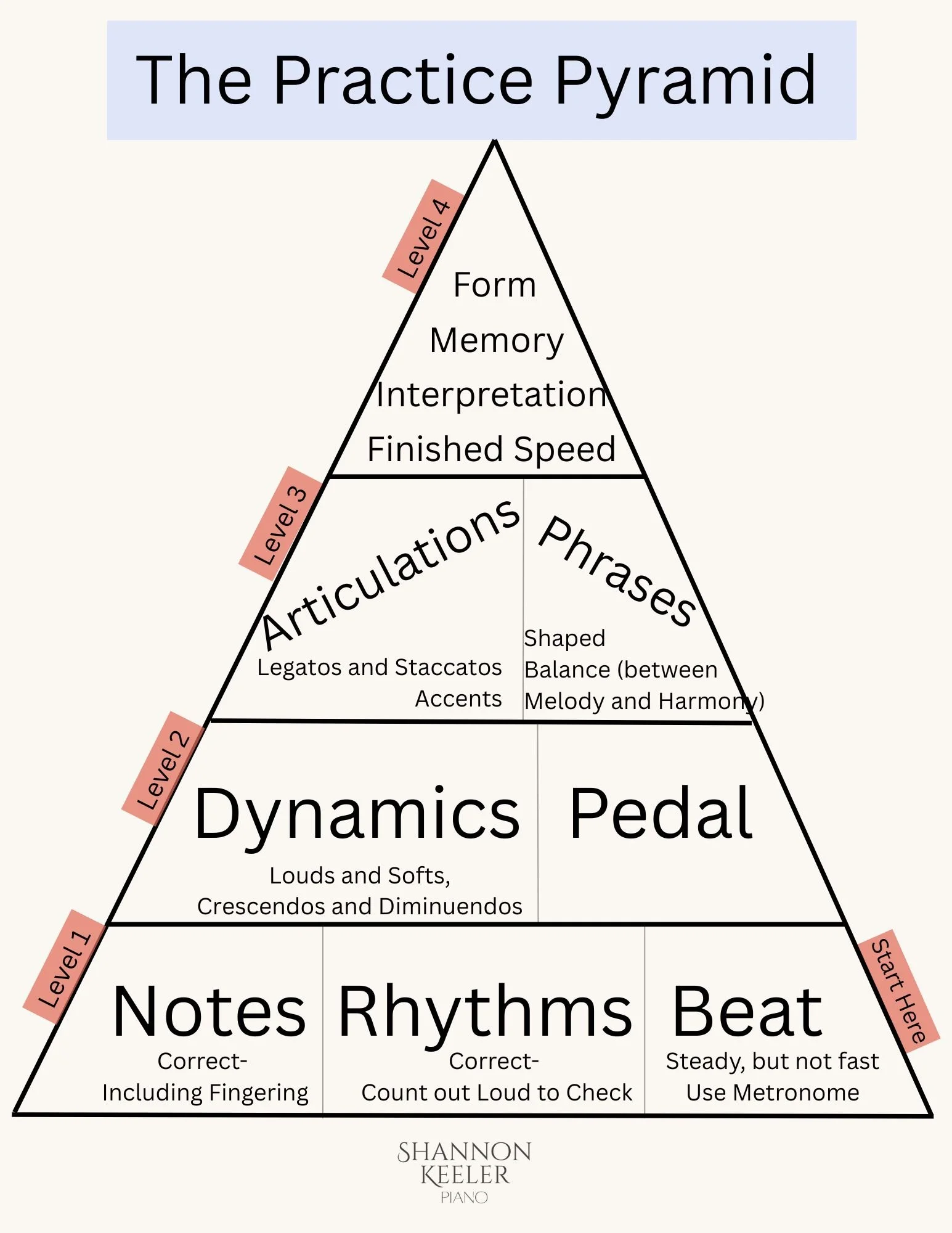
I created the Practice Pyramid years ago to give my advancing students a logical path forward with their more complex pieces. Here’s how to use the pyramid:. Start with Level 1. Once you've mastered those elements, check in with your metronome to make sure you can maintain them with the added accountability of a steady pulse. Then move on to Level 2, then Level 3, and finally Level 4.
One of the biggest mistakes I see students make is trying to add every detail from the very beginning. While you won't ruin a piece by postponing some of the subtler musical details, you can absolutely make life harder for yourself by learning incorrect notes, rhythms, or pauses while trying to do too much at once.
The good news is that as the piece becomes more comfortable through repetition, you'll naturally gain the mental space to add more details. Maybe you notice a forte that contrasts with a piano section. Maybe you begin experimenting with pedal. Maybe a phrase suddenly suggests a particular musical shape.
That's exactly how the process should work. But if not: After you've played a piece 20, 30, or even 50 times, you need to tell yourself, "Oh yeah—it's time to level up." That's when you return to the Practice Pyramid and begin working on the next layer of skills.
A couple of notes about Level 4 of the pyramid:
Form
By "Form," I mean repeats, first and second endings, D.S. al Fine markings, D.C. al Coda markings, and other structural elements.
Here's why I delay these: if you practice a repeated section from day one, that section will receive significantly more repetitions than the rest of the piece. By performance time, it often sounds more secure than everything around it.
Instead, learn all sections of the piece equally first. Once the piece is established, begin incorporating the repeats and formal structure.
Finished Speed
This is the most common question I get from my elementary and intermediate students when we start looking at a new piece:
"How fast should it go?"
Unfortunately, many students then become so focused on reaching the final tempo that they forget everything else that needs to happen first.
The fastest way to learn a piece is usually not to play it fast, but to spend extra time playing it slow and perfect.
By starting slowly and focusing on the broad strokes before the finer details, you're not only getting those details down, you’re injecting a hefty dose of “comfort and ease” into your performance. Over time, this will translate into comfort and ease while playing at faster tempi.
(But spoiler alert—we'll revisit addressing the finished speed at the start when we talk about practice tips for advanced pianists.)
One final thought: not every piece will require every element in the upper levels of the pyramid. Not every piece needs pedal. Not every piece should be memorized. Not every piece contains repeated sections.
But every piece needs a strong Level 1 foundation. Before you worry about speed, memorization, phrasing, or pedal, make sure the notes, rhythms, and beat are firmly in place.
Everything else is built on that foundation.
Advancing Pianists
Ah, to be lucky enough to be an advanced pianist, tackling big, complicated pieces!
If you've reached this stage, you probably already have a few practice tricks and golden habits that helped get you here. But let me share the process I've developed over the years.
When I was younger, I had the luxury of spending four or more hours each day playing, practicing, and listening to my repertoire. As life became fuller with teaching, parenting, and all the other responsibilities that come with adulthood, I had to become much more efficient with my practice time.
My more efficient, adult approach I developed to learning advanced pieces can be summed up as: The Forest. The Trees. Then the Forest Again.
There's an old saying: "You can't see the forest for the trees." Advancing pianists often make one of two mistakes. They either get lost in the tiny details of measure one, or they run through the entire piece without ever addressing the details that need attention.
Instead, I like to move back and forth between the big picture and the small details.
Step 1: The Forest
Before you learn a single note, spend some time getting acquainted with the piece as a whole.
Find a few recordings and listen while following along with the score.
Look for:
Repeated sections
Primary themes
Major mood changes
Tempo changes
Climactic moments
Potential technical trouble spots
Mark these things in your score.
I also like to compare several recordings and jot down the approximate tempi used by different performers. You don't need to play the piece at those speeds anytime soon, but knowing where you're headed can influence your fingering, phrasing, and pedaling decisions from the very beginning.
And notice the artistic elements of the piece: What is the overall mood of this piece? Passionate? Playful? Hurried? Nostalgic? Grand?
Write down a few words that capture the character of the music. Then tuck them into the back of your score, or inside your piano bench. You'll need them later.
Step 2: The Trees
Now it's time to get to work. Choose a section and begin learning the notes. Sometimes I start at the beginning. Sometimes I start with the hardest passage in the piece. Neither approach is wrong.
What matters is that you work accurately and comfortably. But notice- I didn't say quickly.
One of the most important skills advanced pianists develop is the ability to practice at a tempo that allows for success. If you can't play a passage accurately with both hands together, separate the hands. If you can't play it accurately at a moderate tempo, slow it down. Accuracy always comes first.
This is also the stage where fingering decisions become critically important. Choose fingerings that will support the final tempo you're aiming for, not just the slow practice tempo you're using today. Sometimes that means experimenting with multiple fingerings and briefly testing them at a faster speed to see which one feels more natural.
As you repeat passages, gradually layer in additional details:
Phrasing
Articulations
Dynamics
Pedaling
Balance between voices
Countermelodies
Harmonic shaping
But don't rush these details.
A common mistake among advanced pianists is trying to perfect everything simultaneously. Instead, allow the piece to grow naturally. As the notes become comfortable, your attention becomes available for deeper musical decisions.
One final thought while you're among the trees:
ALWAYS Practice comfort. If every repetition feels tense, frantic, and barely under control, you're practicing that feeling into the piece. Choose a tempo and chunk size that allow you to feel relaxed and successful. Comfort is not laziness—it's efficiency.
And don't allow weeds to take root! Wrong notes, incorrect rhythms, unnecessary pauses, and tension are all much easier to prevent than they are to remove later.
Step 3: Return to the Forest
Eventually, you can play the piece reasonably well from beginning to end.
Now it's time to zoom back out.
Play complete run-throughs and listen carefully. Every hesitation, balance issue, memory slip, or moment of tension is like a warning light on your car dashboard.
Don't ignore it! Stop. Fix it. Then continue.
This is also the time to revisit the mood you identified during your first walk through the forest. Does the piece feel the way you imagined it would? Does it communicate the character that drew you to it in the first place? If not, keep refining.
Recording yourself can be especially valuable during this stage. The pressure of a recording often exposes weak spots, memory lapses, and awkward musical moments that don't reveal themselves during everyday practice.
As you move toward performance, pay special attention to:
Overall flow
Stability under pressure
Climactic moments
Tempo relationships
Rubato and expressive timing
Consistency of mood and character
And hopefully, with good focus and regular, disciplined practicing, your song sounds remarkable close up and zoomed out!
Conclusion:
Efficient practicing isn't about spending more time at the piano—it's about making the time you do spend count.
Whether you're learning your very first song or tackling a giant sonata, thoughtful, consistent practice is what transforms difficult music into comfortable music.
So sit down. Just do it.
Then enjoy the best part of all: making beautiful music.
Happy Practicing!
—Shannon
Need some pedal support? Check out my article: "Mastering the Damper Pedal in 4 steps