
How to Read Piano Music: Tips to Becoming a Fluent Note Reader
Disclaimer: This post contains affiliate links. If you click through and make a purchase, I’ll be compensated at no cost to you. I only recommend products I use myself.
There are many ways to play songs on the piano.
You can play by ear, where you hear a song, then try and reproduce it without aids. You can play by rote, where you watch someone play the song, then copy what they are doing. You can play from lead sheets, which contain a melody written out on one set of staff lines, and chord symbols above that you use to create your own version of a song. And you can play from standard grand-staff notation, where all of the notes you are to play are noted out for you over two sets of staff lines.
All four are legitimate ways of playing music. In fact, it’s common for us musicians to use several of them. But as the music you want to play becomes more complex, or if you want to play unfamiliar music, fluent grand-staff reading becomes increasingly important.
How, then, does one go about becoming a fluent note reader?
I have found that the most effective note readers don’t simply memorize the note names of the staff lines and spaces. There is a second skill involved as well: recognizing the direction that the notes are moving in relation to one another. Good piano score reading involves fluency with both of these skills.
But first: What exactly is the grand staff?
Staff lines are the sets of five lines (and four spaces) that musicians use to read notes from. Most instruments and voices only need to read from one set of staff lines. However, because the piano has such an enormous pitch range, we pianists need to read from the grand staff. The grand staff combines the treble and bass clefs, which accounts for the notes around the central range of the keyboard.
The grand staff has room for most of the primary notes we play. When we need to notate notes higher or lower than the grand staff, we use ledger lines: short little lines in, above, or below the notes that act like little extra staff lines.
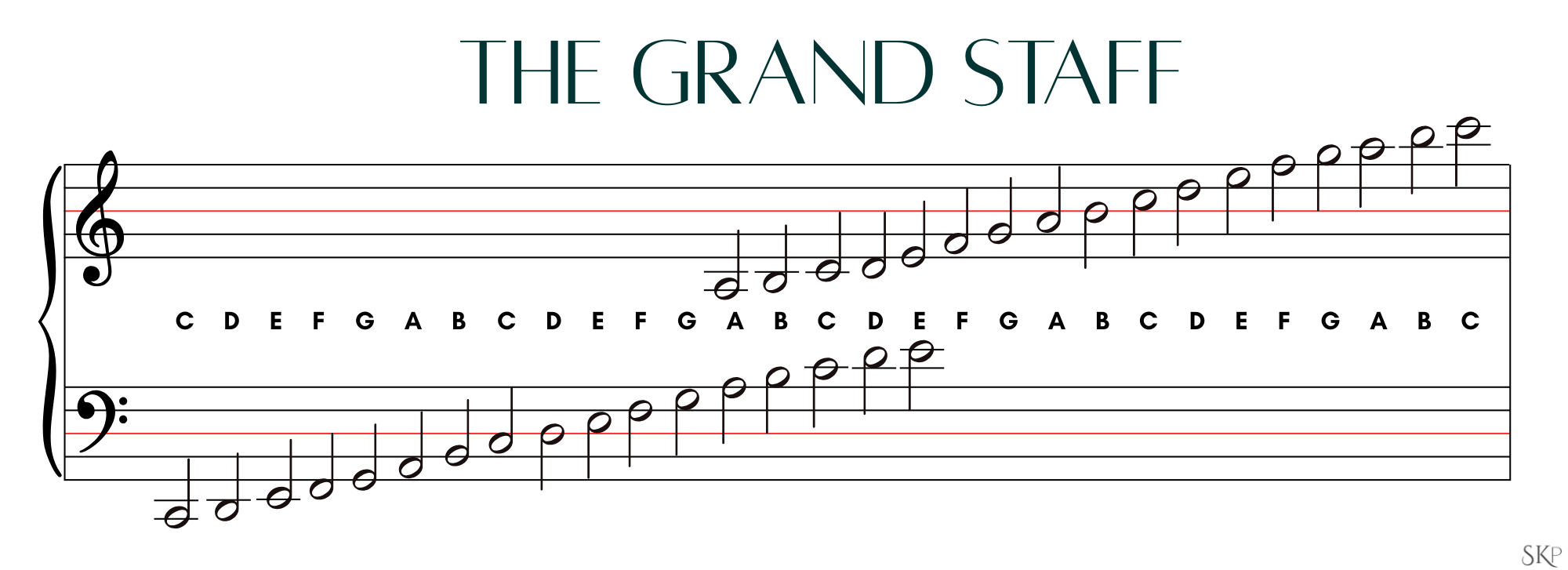
Good note reading does involve knowing the names of each line and space on the staff. However, that is only part of the picture. It’s like a cook knowing the names of all the ingredients in a recipe- it’s important, but that alone doesn’t make the recipe happen!
“Should I Put Stickers on the Piano Keys?”
This is a question I often get from beginning piano students, or the parents of beginning piano students. Stickers that go on piano keys showing a mini-staff and the note’s name can seem like a helpful shortcut. But if your goal is to become a fluent music reader, I don't recommend relying on them for very long, or using them at all. Our goal isn’t just “see the note on the page and find the matching sticker.” Our goal is to see the bigger picture itself- how this note works with its neighbors. Stickers can become a crutch because they separate the notation from the keyboard geography.
Instead, pull the “band-aid” off, buckle down, and get solid with two skills: Note Identification and Directional Reading.
Note identification
Note identification is being able to say what the name of a note on the staff is, and what key on the piano correlates with it. This is an essential piece of information- otherwise, how will you know where to start a piece of music? Or, if there’s a big gap in the line of music, how will you know where the line jumps to?
Here’s where mnemonics can be helpful. Mnemonics means using a saying to remember the names of the lines in the treble and bass clef, and/or spaces: FACE, Every Good Boy Does Fine, etc. What makes mnemonics slightly more complicated for us pianists is that we need to keep them all straight- the mnemonics that work for the treble clef do not work for the bass. We need different ones. Because of this, I encourage my students to use mnemonics they can remember- in the old days we used “Every Good Boy Does Fine” for the treble clef and “Good Boys Do Fine Always” for the bass. If that’s working for you, go with it! However, it is easy to get all those good boys mixed up for some students. Here’s another, no “good boys” required:
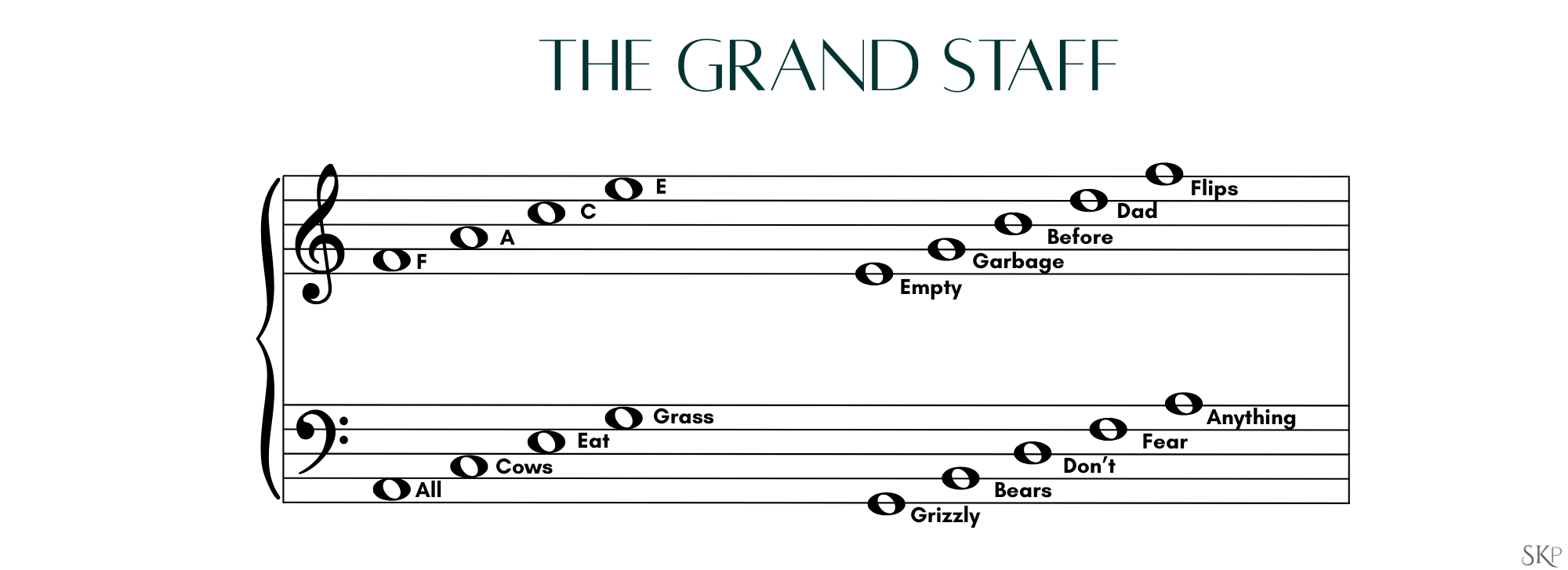
Whatever saying you use, remember- mnemonics always go from the bottom line or space upwards.
Other tools to get savvy with note identification:
Flashcards. Flashcards can be helpful for improving your note identification. However, don’t just say the answer. Sit at your piano as you go through the deck, and play the answer. Then, flip it over to check that you got it right. Be sure and find flashcards that show the grand staff on the front, not just treble or bass clef, for optimal note-reading identification practice. ***Click here for the flashcards I recommend to my students.
Notespellers. Notespellers can also be beneficial, especially if you find it helpful to reinforce facts by writing them repeatedly. I have recommendations for two of my favorite note spellers at the end of this article.
Say your note names as you play. After you’ve played through an easy song a few times, try saying the note names aloud as you play. One bit of caution with this however; practicing in this way is helpful only for working on note identification. It WILL slow down your tempo and make it difficult to play musically. Use as part of your note-identification practice, not something you do every time you play a song!
Directional Reading
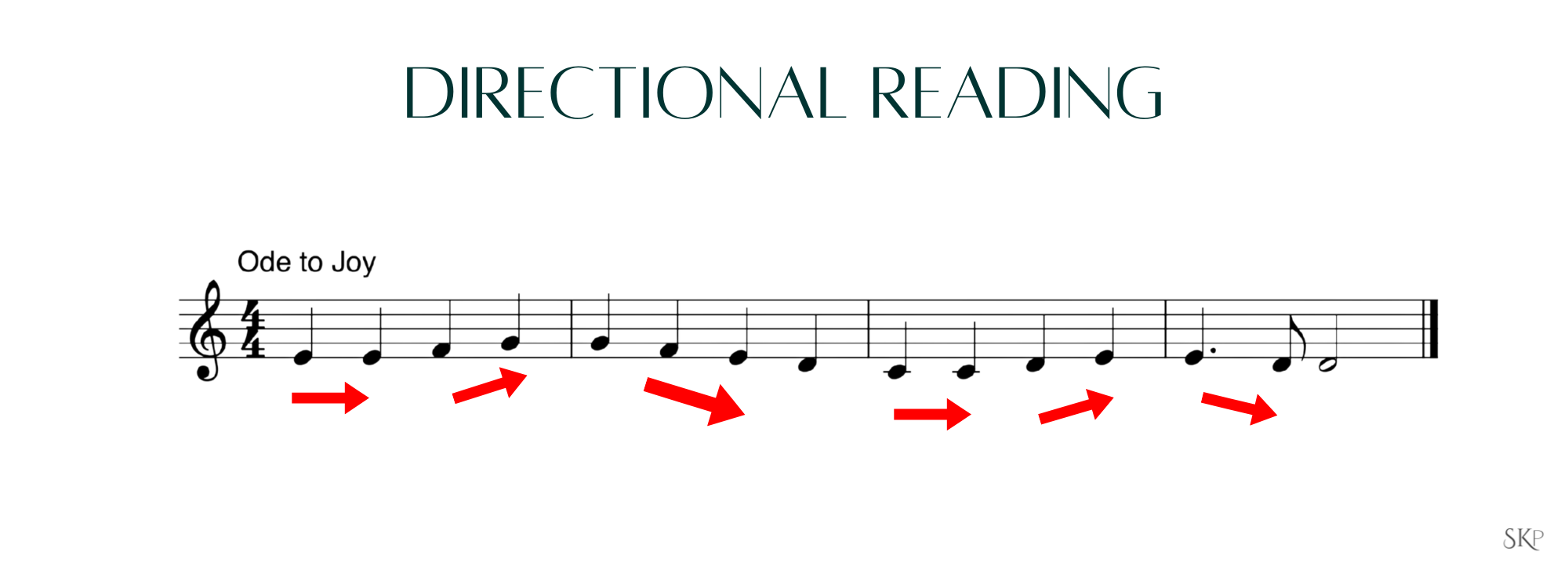
Directional reading is to look at the note following the one you are playing, and noting if it repeats or moves up or down. Noting the note movement as up or down when the notes are stepping (going in order from one note to the next) is fairly easy, even for beginning note readers. More advanced note readers also have a solid understanding of the “gaps,” or intervals, in the line, and know how to correlate these gaps on the piano.
Reading by direction is helpful for quicker, more fluent note-reading. It simplifies playing tremendously - when playing, directional readers simply think “start on E, repeat, step up, step up, repeat” instead of identifying each note on the staff, one by one, and translating that onto the corresponding piano key.
Directional reading is not a new concept. In fact, Guido d’Arezzo, the Italian monk who invented our notation system of staff lines and spaces, used it as the base for his entire staff system back in 990-1030! Béla Bartók relies on it to teach note reading in his Mikrokosmos series (1940), and Frances Clark used it as the basis for her classic piano education series, The Music Tree (1958). Directional reading brings us closer to the essence of music than note identification, which gives beginners a leg-up to playing smoother and more confidently right out the gate.
Tools to get solid with directional reading:
Verbalize the direction of the musical line as you play. As you play a melody (or a bassline), say out loud the direction that the music is moving: “repeating, stepping up, stepping down, skip up,” etc. Like saying your note names aloud as you play, use this as a tool for improving your notation reading, not as a default for all of your playing, as it will slow you down.
Transposing. Transposing means taking music and playing it in a different key (scale). When we are transposing, we can only rely on the directional movement of the notes. Start small- take a simple 5-finger melody, and change your starting note to G. Or C. Or F. Don’t worry about working in the black keys (accidentals) of the scale at first.
Music that emphasises directional reading for early readers. While you can definitely work on your directional reading with whatever beginner music you have already, there are a couple sources I recommend to students who need a little more structure with this. Bartok’s Mikrokosmos, Book 1 (click here) starts simple, and has the added benefit of melodies that are not common to our Western ears. You will have to rely on your directional reading for sure to play these exercises! And the seven volume series Sight Reading and Rhythm Every Day by Helen Marlais and Kevin Olson organizes a week of progressive directional reading exercises for you, with the added bonus of a daily rhythm exercise to accompany it!
A Daily 5-Minute Notation Reading Routine
I know, this sounds like a lot! But it really doesn’t have to be complicated. Try adding this mini-session onto your daily practice, and see how your notation reading improves after a few weeks:
A 5-Minute Piano Notation Reading Routine:
1 minute- Note Identification. Spend a minute with your flashcards, saying and playing the answers, OR play a tune you’ve already learned, watching the score and saying the note names aloud as you play.
2 minutes- Directional Reading. Find an easy melody in one of your beginner books. As you play it, say the direction that the notes are moving: “Stepping up. Repeating.” etc. Then, transpose that entire melody slightly higher or lower, by changing your starting pitch.
2 minutes- Sight Reading. Find a simple melody or piece you’ve never played before. Look over it visually first, then play through it slowly without stopping. Then, look at any spots that didn’t go well the first time, try and figure out what went wrong, and play it one more time.
Conclusion
Playing the piano can be overwhelming at times with the many different areas we need to focus on. But just like all of your piano skills (scales, pedaling, rhythm, increasing technical demands), if you focus and work diligently on your notation-reading for a few minutes every day, it will get easier.
Be efficient with your valuable practice time, however, and tackle note reading with the two-pronged approach of note identification mastery and directional reading mastery.
It will be well worth your efforts, I promise. Playing those advanced pieces may seem like it’s a ways off, but you will be happy that you took the time to become fluent in note reading once you get there.
Happy Playing!
Shannon
Resources:
My free, downloadable “Grand Staff Note Naming Resource”
My top recommendation for Note Naming Flashcards - Hal Leonard Music Flash Cards
FJH Classic Notespeller, book 1, by Carol Matz (good for older beginners, has you working on larger sections of the staff at once)
Andrea and Trevor Dow’s “Timed Note Reading Tests for Piano, Books 1 and 2” (best for kids, slow pacing that focuses on a handful of specific notes with each page)
Béla Bartók, Mikrokosmos, Book 1
Helen Marlais and Kevin Olson’s “Sight Reading and Rhythm Every Day”